More than half (55%) of UK scam victims believe synthetic voices or deepfake images were used in the fraud that targeted them, as cybercriminals harness AI to impersonate trusted brands consumers buy from and interact with every day, according to research by Kaspersky. By posing as well-known companies and using convincing voices and visuals, scammers are tricking people into handing over money, with some consumers falling victim to scams on five separate occasions.
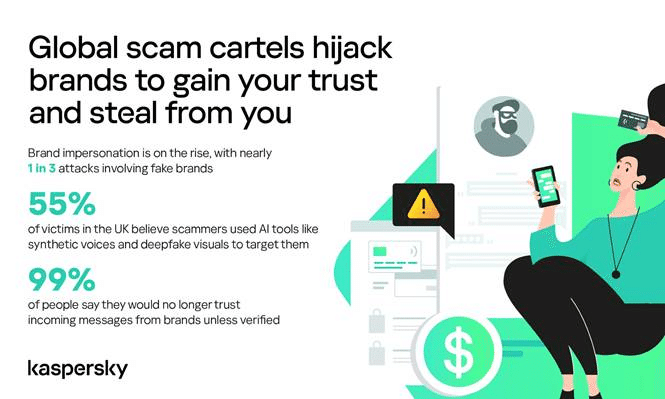
Brand impersonation is now one of the three most common types of
messaging scams worldwide (31%), rising to 35% among UK consumers. By posing as
recognisable companies and reproducing the kinds of alerts consumers receive
every day, criminals can use a familiar brand name to persuade victims to hand
over personal information or make payments they believe are legitimate.
Consumers are losing money to fake versions of trusted brands
Kaspersky’s research found that 99% of consumers do not trust
incoming notifications on messaging channels after being scammed. A fake
delivery update, payment request, account alert or customer-service message can
therefore do more than cause an immediate financial loss: it can also make
victims question genuine communications from brands they previously trusted.
These scams exploit ordinary consumer habits by preying on people’s trust of brands they frequently interact with. Messages are designed to look like routine interactions with well-known companies, placing fraudulent payment demands and requests for personal information in the same channels people use for purchases, deliveries and customer support.
More than one in four affected consumers worldwide (28%) report being scammed three or more times, increasing to 30% in the UK. For the average victim, the most recent incident happened within the past six months.*
AI is industrialising brand impersonation
AI is enabling cybercriminals to produce and refine impersonation attempts with greater speed, scale and realism. According to the study, two-thirds (66%) believe AI played a role in the scam they experienced, including AI-written messages (43%) and synthetic voices (31%) designed to make fraudulent communications appear natural and credible. In the UK, 42% believe their scam message was written by AI.
For scammers, this means a familiar company’s tone, imagery and customer-service style can be reproduced and adapted rapidly. Consumers can no longer assume that correct branding, natural language, a convincing voice or a realistic image proves that a request for payment or personal data genuinely comes from the brand it claims to represent.
Scams are spreading across the messaging platforms people use
every day
Crucially, these scams are taking place across the channels brands
and consumers rely on most. Worldwide, almost half (43%) begin on WhatsApp,
followed by SMS/iMessage (40%) and Facebook (27%). In the UK, SMS/iMessage is
the leading starting point (44%), followed by WhatsApp (39%) and Facebook
(24%).
What's more, almost two in three scams (63%) span multiple platforms before victims realize what's happening. This cross-platform approach increases credibility and makes scam detection more difficult.
With legitimate and malicious messages appearing in the same environments, often with similar formats and timing, consumers are left to make judgement calls without clear or strong trust signals.
Robert Siciliano, renowned security expert and CEO of Protect Now, explains:
"The surge in AI-driven brand impersonation represents a sophisticated form of emotional manipulation, where digital criminals exploit our natural trust by perfectly mimicking the companies we interact with daily. By creating false alarms and high-pressure situations, these attackers exploit a common trust gap"
He concludes:
"To restore confidence, businesses must transition from basic defense to a more proactive strategy, closing information gaps so customers can spot the subtle signs of a scam before they are tricked into giving away their sensitive data’
What brands should do to help protect consumers
Kaspersky recommends three steps to help consumers recognise
genuine communications and avoid impersonation scams:
• Educate consumers and employees: warn customers about active scams and train staff to spot threats. Kaspersky Security Awareness training helps 95% of trained employees identify phishing attacks.
• Set clear communication boundaries: state what the brand will never request through messaging platforms and direct sensitive actions to verified channels.
• Invest in robust security tools: use Kaspersky Brand Monitoring to detect impersonation and Kaspersky Takedown Service to remove harmful content quickly.
"AI has accelerated brand impersonation scams to a point where trust in everyday messages is slowly eroding," said Maria Isabel Manjarrez, Senior Security Researcher at Kaspersky's Global Research & Analysis Team (GReAT).
"Our research shows people are finding it increasingly difficult to distinguish between legitimate messages and fraudulent ones, and as a result, confidence in trusted brands is waning."
She concludes: "In response, businesses need to move beyond reacting to individual incidents and focus on prevention, through stronger detection capabilities, clearer communication practices, and ongoing customer education."
For more information on Kaspersky’s insights and recommendations for safer online interactions, visit Kaspersky Daily.
The full research
report is available here.
Research methodology
*The survey was conducted by Censuswide on
behalf of Kaspersky in April 2026, gathering insights from 2,806 messaging-scam
victims aged 16-61 across Europe (United Kingdom, France, Germany, Italy,
Spain, Portugal, Greece, Serbia), North America (United States of America), and
Africa (Morocco, Senegal, Ivory Coast).


