Kaspersky’s new report reveals a surge in preinstalled Android malware in 2026, with the monthly number of infected devices jumping more than twofold between November 2025 and October 2026. Embedded directly into system firmware or preinstalled system applications, these threats may be active across a wide range of Android devices, from smartphones and tablets to TV boxes, car head units and even children’s smartwatches. Preinstalls pose some serious risks to data safety, user privacy and enterprise security.
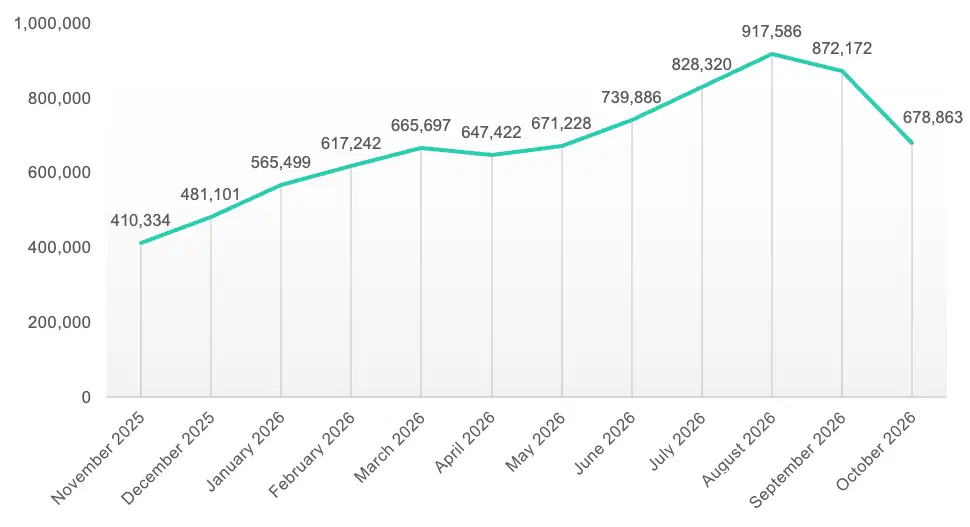 The number of Android devices with preinstalled malware detected
by Kaspersky solutions,
November 2025 – October 2026
Preinstalled malware reaches end-user devices primarily through supply chain compromises occurring at various stages of hardware manufacturing and software assembly. Kaspersky researchers identified three main infection vectors:
- manufacturers deliberately embedding backdoors into low-cost or counterfeit hardware;
- device vendors unknowingly receiving compromised firmware builds from rogue third-party contractors;
- legitimate manufacturers building firmware from infected open-source bases or third-party code components without realizing the build environment has been compromised.
Kaspersky’s research shows that the mobile threat landscape now is dominated by sophisticated, modular preinstalled malware. In the first ten months of 2026 alone, just two malware families – Triada and Keenadu – accounted for 88% of all detected preinstalled infections. Triada leverages modular architectures to inject code into any installed app, intercept SMS and calls, and steal login credentials. By operating with system-level privileges directly from within the firmware, Triada hooks into core operating system processes, enabling it to inject custom malicious modules straight into the runtime memory of any target app on the device – whether it is a system utility or a user-installed application.
Meanwhile, Keenadu was detected on more than 220,000 devices during the same period. Much like Triada, Keenadu relies on a modular architecture that empowers attackers to remotely download specialized payloads and inject them directly into target applications, allowing the backdoor to perform virtually any action on the device – from click-fraud manipulation to data extraction. Additionally, Keenadu may use a delayed activation mechanism that waits approximately 2.5 months after first contacting its command-and-control server.
Different types of preinstalled threats are not limited to smartphones: malware strains such as Dwphon, Vo1d, and BADBOX have been discovered inside other devices as well. For instance, Dwphon was found on children’s smartwatches, and Vo1d – on Android TV streaming boxes.
“When malware is embedded into device firmware, the trust model between hardware vendors and enterprise IT breaks down. Compromised firmware can expose internal corporate networks, leak sensitive enterprise secrets, draft devices into botnets, cause operational downtime, and result in substantial reputational damage. Organizations can no longer treat factory-fresh hardware as inherently safe. As attackers increasingly target the supply chain, mobile security strategies must shift from reactive post-infection response to proactive verification of hardware builds and zero-trust mobile endpoint management,” commented Denis Parinov, Head of Threats Monitoring and Heuristic Detection at Kaspersky.
The full report is available on Securelist.
To counter the growing threat of preinstalled mobile malware, Kaspersky offers comprehensive B2B solutions designed for both corporate fleets and device manufacturers. Kaspersky Next EDR Optimum functions as an Advanced MDM platform that combines Mobile Device Management (MDM) controls with real-time antivirus scanning. Because firmware-level malware cannot be uninstalled through standard system procedures, Kaspersky Next EDR Optimum alerts IT administrators instantly upon detection, allowing them to isolate infected devices, block network access, execute remote data wipes, and enforce credential resets. Additionally, for hardware manufacturers and firmware developers, Kaspersky Scan Engine integrates directly into software assembly pipelines, enabling real-time file and firmware auditing to eliminate preinstalled threats before devices enter commercial supply chains.
About Kaspersky Threat Research
The Threat Research team is a leading authority in protecting
against cyberthreats. By actively engaging in both threat analysis and
technology creation, our TR experts ensure that Kaspersky’s cybersecurity
solutions are deeply informed and exceptionally potent, providing critical
threat intelligence and robust security to our clients and the broader
community.


