A text arrives from a number you don’t recognize, addressed to someone named Alex or Mia. It looks like a genuine mistake. But wrong number text scams are built on that assumption, and the sender’s goal is for you to correct it.
Every reply, including a polite “sorry, wrong person,” confirms your number is active and that a real person is paying attention. From that point, how much damage is done depends on how long the conversation continues.
What you need to know:
- A wrong number text is a deliberate opener, not a misdirected text sent to your number accidentally.
- Replying to any wrong number text confirms your number is active to the sender.
- Scammers use these messages to recruit targets for pig butchering scams and other long-running financial frauds.
- Blocking and reporting the sender is the correct response, not politely correcting the mistake.
- Clicking any link in a follow-up message can install malware or deliver a page designed to steal your credentials.
- Built-in phone filters and security software reduce how often these messages reach you.
What is a wrong number text scam?
A wrong number text scam is a deliberate message sent to appear as a misdirected text. The sender already has your number and uses the fake mistake as a way to open a conversation. The goal is always the same: to build enough trust that you hand over money, personal information, or both.
Wrong number scams work differently from standard spam texts that push a link or a deal immediately. With a wrong number scam, the opening message gives no indication of any threat. When you reply, even if it’s a brief correction, the sender treats your response as a signal to continue the interaction. From that point, the attacker treats your response as an invitation to keep talking.
How does it differ from a genuine wrong message?
A genuinely misdirected text resolves in one exchange. A wrong number scam continues after you correct it.
Real senders who reach the wrong number would apologize briefly and stop messaging. Scammers, on the other hand, often respond to your correction in a casual and conversational way, ask how your day is going, or find another reason to keep talking. Nothing in the conversation feels urgent or suspicious. They do this deliberately, they don’t want to alarm you, but to build the habit of a regular, friendly exchange.
Why do scammers send wrong number texts?
The fake wrong number achieves two things: it filters out unresponsive numbers and identifies people who are willing to engage with a stranger. Those are the targets who move to the next stage of the scam.
Scammers maintain vast lists of phone numbers that they harvest from data breaches, purchase from data brokers, or generate algorithmically. They then send a convincing-looking wrong number text to each of the numbers of their list which costs almost nothing at scale. The replies separate confirmed, active numbers from inactive ones and identify the subset of people willing to interact.
What are scammers trying to achieve long term?
The outcome depends on the scam, ranging from data collection to financial fraud. The wrong number text is the opening move.
Some operations stop at number validation. The scammer then sells confirmed contact lists to other attackers. Others escalate to phishing, where a manufactured emergency gives the scammer a reason to request personal details or send a malicious link.
Why are wrong number scams increasing?
Volume and automation are the two main drivers behind the increase in wrong number scams. AI tools now generate and vary message templates at a scale no manual operation could match.
A wrong number message from ten years ago was usually a genuine accident. Today the same-looking text may be one of thousands sent within a single hour. AI-generated content makes those messages harder to dismiss as obvious spam: names feel local, contexts are plausible, and wording passes basic carrier filters. The US Federal Trade Commission documented a sharp rise in text scam reports and consumer losses from 2020 onward.
Why do these scams work so well on people?
These scams exploit the impulse to be helpful to a stranger who seems confused. That same openness, once engaged, makes people receptive to the friendly, low-pressure conversation that follows.
Messages stay friendly and undemanding throughout, giving no reason to be suspicious. Weeks pass and the manufactured rapport starts to feel like a real connection so, by the time any financial request appears, the target has been exchanging daily messages with someone they have never met. When the request does arrive, it feels like a request from a friend, not as a demand from a stranger.
While wrong number scams are one common entry point, scammers also use other types of text messages to reach potential victims.
What are the most common text scams?
Most text scams share one structure: an opener that feels routine, a reason to keep talking, and a request for money or personal data. The delivery changes; the sequence does not.
Pig butchering and investment fraud
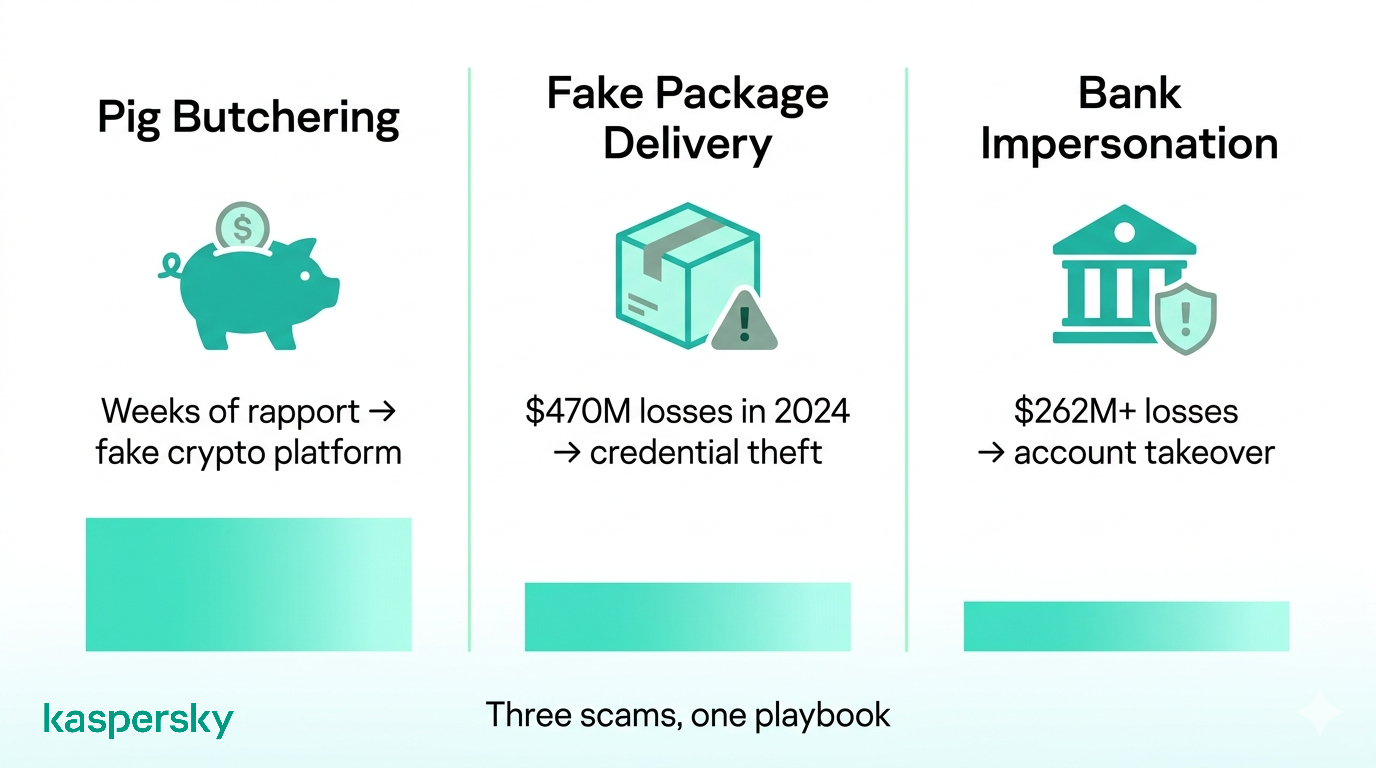
The most financially damaging outcome is pig butchering: weeks of friendly conversation that slowly shifts toward a cryptocurrency platform the scammer controls. The money you transfer shows fabricated profits until you try to withdraw it, at which point the platform and the person both disappear.
In one reported case, a Bay Area man lost $1 million after a wrong number text led to a months-long relationship with someone he knew only as "Tina," who eventually directed him toward a fake cryptocurrency trading platform.
Example exchange:
Scammer: "Hi Michelle! Still on for dinner Saturday? Can't wait to catch up!"
You: "Sorry, I think you have the wrong number."
Scammer: "Oh no, how embarrassing! Sorry to bother you. Are you having a good week at least?"
[Days pass. Daily messages. How was your weekend? What do you do for work? You seem like a really interesting person. Let’s chat on Telegram, I’m away for the weekend and only have Wi-Fi signal.]
[Weeks later] Scammer: "My uncle manages a trading fund. I've been learning from him. Made more in the last month than I used to make all year. I don't tell many people but I feel like I can trust you."
Fake package delivery texts
A text claims your parcel cannot be delivered and asks you to click a link. The link leads to a page designed to collect your card details or home address. The FTC reported $470 million in losses to text-based scams in 2024, and package delivery messages were the single most-reported type.
In 2024, a security researcher whose wife clicked a fake USPS link traced the operation and found it was sending 100,000 texts per day, with 390,000 stolen card numbers in its database.
Example message:
“USPS ALERT: Your package #7748320 could not be delivered. Confirm your address to reschedule: [link]”
Bank and payment impersonation
A text appears to come from your bank, warning of suspicious activity on your account. When you call back or click through, you reach a scammer who explains how to transfer your money “to safety.” It’s effective because it creates urgency, encouraging you to take immediate action without thinking whether it might be scam.
In one reported case, a Florida couple lost $42,000 after a scam text led to a call from someone posing as a Chase representative. And, since January 2025, the FBI’s Internet Crime Complaint Center received more than 5,100 complaints about account takeover fraud linked to financial institution impersonation, with losses exceeding $262 million.
Example message:
“[Bank Name] Fraud Alert: A $1,240 purchase was attempted on your account. If this wasn’t you, reply STOP or call us immediately at [number].”
How do wrong number scams work step by step?
A scammer sends a text that looks like a misdirected message. When you respond, the conversation turns friendly and continues for days or weeks. Eventually the scammer introduces a financial opportunity or a request for money.
The opening message names someone you don't know and includes a plausible detail such as a restaurant, an address, or a meeting time to make the mistake feel genuine. When you correct the mistake, the sender apologizes warmly and finds a reason to keep the conversation open.
They might ask questions about your day, with exchanges becoming more frequent and more personal. At some point the attacker suggests continuing the conversation on another messaging app. A financial opportunity or an urgent story requiring money appears when the relationship feels established.
Why do scammers move conversations to WhatsApp or Telegram?
Scammers move to WhatsApp or Telegram to take the conversation off a channel your carrier can monitor. SMS traffic passes through carrier infrastructure; encrypted apps block that oversight entirely.
Reporting a suspicious SMS to your carrier via the 7726 shortcode works because carriers can see that traffic and act on it. Once a conversation moves to WhatsApp or Telegram, that option is gone. Scammers also gain additional tools on those platforms, including detailed profile photos that manufacture credibility, the ability to delete sent messages without the recipient knowing, and access to group chats used to mimic social proof for fake investment schemes.
What are the key warning signs of a wrong number text scam?
The clearest warning sign is persistence: a genuine wrong-number sender stops once they know they reached the wrong person. A scammer apologizes and keeps the conversation going.
Watch for these additional indicators:
- The opening message names someone you don't know and includes a specific, unverifiable detail such as a restaurant or a meeting time.
- Messages arrive at consistent intervals and always stay friendly, even when there is nothing particular to say.
- The sender proposes moving to WhatsApp or Telegram early, usually framed as more convenient.
- Profile photos look too polished: professional lighting, no candid shots, images that could belong to anyone.
- After several weeks of warm, purposeless chat, a financial opportunity or a request involving money appears.
What happens if you reply to a wrong number scam?
Replying confirms your number is active and moves you onto a list of responsive targets. The risk stays low if that is all you did. It rises sharply if you keep talking, click a link, or share personal details.
What if you only replied without sharing information?
Replying confirms your number is active. The practical consequence is increased targeting, but there is no immediate account risk. Block the sender now and do not respond to any further messages. Your accounts and personal data are not at risk at this stage.
What if you clicked a link or shared personal details?
Act immediately, your accounts and personal data are at risk. Change your passwords without delay, starting with your email account, and contact your bank if you shared any financial information with the scammer.
What should you do if you receive a scam text?
Block the sender without replying. Then report it to your carrier via 7726. It takes under a minute and flags the number across the network.
Blocking is straightforward on both main platforms:
iPhone: open the conversation, tap the sender’s name at the top, scroll to the bottom, and select “Block this Caller.”
Android with Google Messages: open the thread, tap the three-dot menu, and choose “Block.” Once blocked, the sender cannot reach you through that number.
How do you report text message scams?
Both iPhone and Android have built-in reporting options that send the message to your carrier in one tap. Forwarding to 7726 does the same thing on any network at no cost.
iPhone: tap "Report Junk" below an unknown sender's message thread before opening it.
Android with Google Messages: open the conversation menu and select the spam report option.
Each report feeds into carrier-level detection that helps identify numbers running mass scam and phishing campaigns.
What should you do if you already engaged with the scammer?
End the conversation immediately and block the number without responding further. The longer the exchange continues, the more an attacker can build on what you have already shared. Take note of what was said before closing the conversation.
Do not threaten to report the sender before blocking. It signals that you are still engaged and gives the attacker a reason to escalate. Once you have blocked the number, check through the conversation and note anything you disclosed: names of friends, colleagues, or family members, your workplace, your routine, or any financial details. People you mentioned by name may now be part of a profile the attacker is building. Let them know so they can ignore any contact that follows.
How do you secure your accounts and data?
Change your passwords from a device you trust, starting with your email. Turn on multi-factor authentication on each account. Then check login history for sessions you do not recognize.
To reduce risk across multiple accounts and devices, tools like Kaspersky Premium can help detect phishing attempts, block malicious links, and monitor for suspicious activity in real time.
Work through your remaining accounts in order of sensitivity: banking, then social media, then any platform you mentioned during the conversation. If you find anything suspicious, most platforms let you sign out all active sessions remotely.
If you shared your home address, date of birth, or government ID numbers, contact the relevant credit reporting agencies. In the United States, those are Equifax, Experian, and TransUnion.
If the scam started on your phone, your device may also be at risk. A security app with real-time link scanning and malware detection can identify threats that arrived before you knew what you were dealing with, and block the next attempt before it reaches you.
Stay ahead of text scams
Kaspersky Mobile Security scans links in real time, detects malware, and blocks threats before they reach your data. Available for iOS and Android.
Try Kaspersky Mobile SecurityHow can you prevent wrong number scams in the future?
Do not reply to a text addressed to someone else, even to correct the mistake. That single non-response is the most effective thing you can do.
There are also two phone settings that take less than two minutes to activate and filter out most scam texts before they reach you.
Which settings and tools help block scam texts?
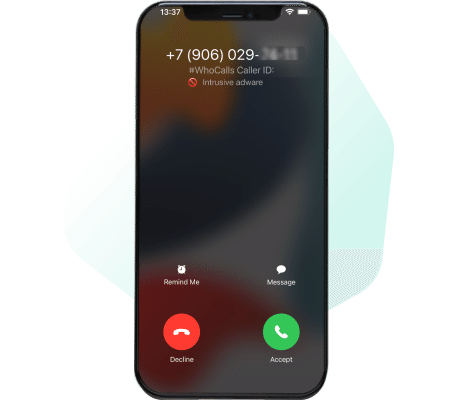
On iPhone, go to Settings, then Messages, and enable "Filter Unknown Senders." On Android with Google Messages, open Settings and turn on Spam Protection. Some tools can also identify suspicious callers in real time before you interact.
Security software with real-time URL scanning checks links against known malicious domains before you tap them. If a message does reach you and you tap a link before realising what it is, active malware detection can catch the threat before it takes hold. Kaspersky's resource on phishing prevention explains how to build these defenses across email and SMS.
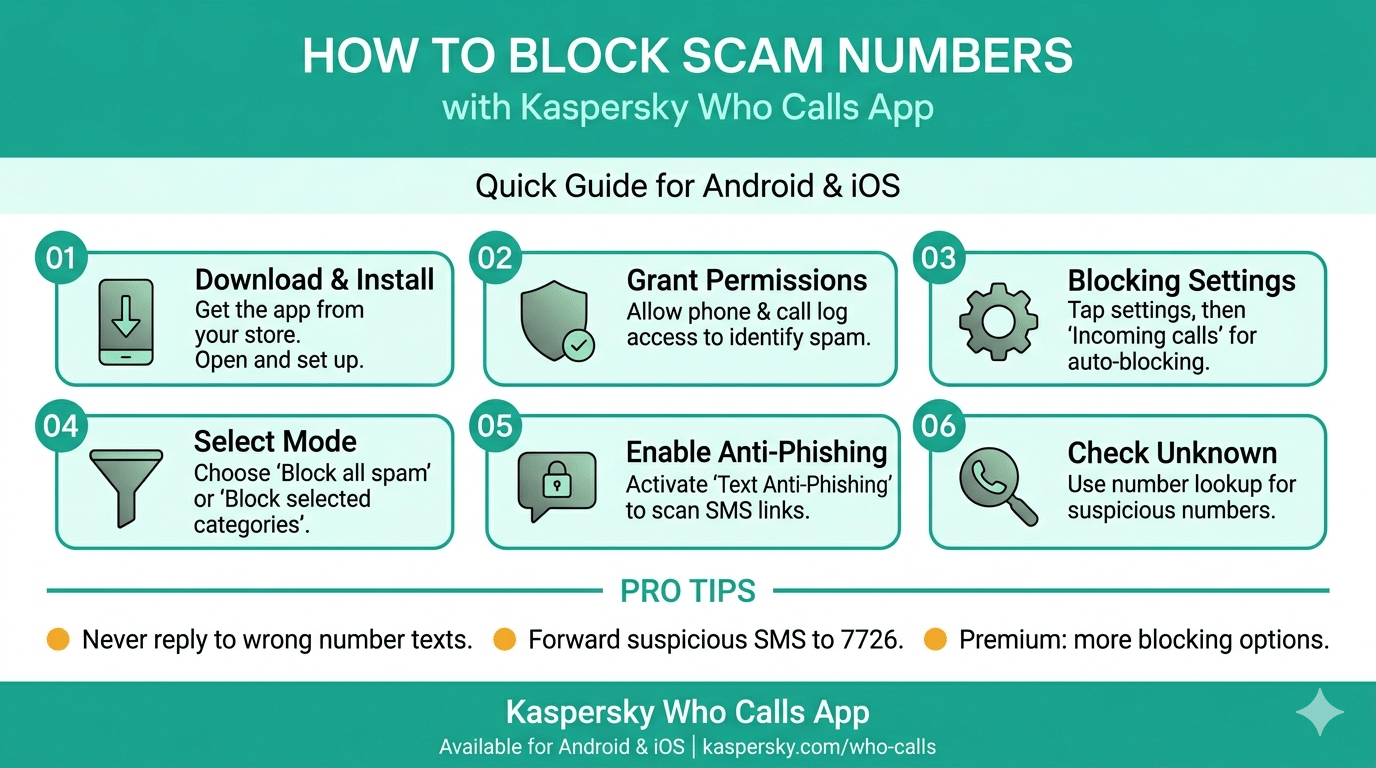
How to block scam numbers and texts step by step
Blocking scam calls and messages is more effective when detection and filtering work together. The steps below show how to stop unwanted contact automatically.
Follow these steps to block scam calls and texts:
-
Download and install the app
Get the app from your app store, open it, and complete the setup. -
Grant permissions
Allow access to phone and call logs so the app can identify spam. -
Enable blocking settings
Go to settings and activate incoming call blocking. -
Select blocking mode
Choose whether to block all spam or only specific categories. -
Enable anti-phishing protection
Turn on text anti-phishing to scan SMS links for threats. -
Check unknown numbers
Use number lookup to identify suspicious callers before responding.
Related Articles:
- What are the risks associated with SMS attacks?
- What is smishing and how to defend against it effectively?
- What can scammers do with your phone number?
-
What are the best Phishing prevention tips to stay safe online?
Related Products:
FAQs
Can a wrong number text scam infect your phone without clicking anything?
Receiving a text does not install malware or compromise your device. That requires a clicked link or a downloaded file. Delete the message without interacting and your device is not at risk.
Why do scammers keep texting even after you don’t respond?
Scammers use automated tools that run on a fixed schedule regardless of whether anyone replies. Your silence is not a signal to stop. Block the number rather than waiting for the sequence to expire.
Can scammers use your phone number for other scams?
Yes. A confirmed active number may be sold across scam networks or used in further campaigns. Your number can appear in phishing calls, smishing waves, or caller ID spoofing operations. Combined with data from other sources, it can also be used for targeted social engineering.
Are wrong number scams only sent by real people?
Not always. Automated systems handle the opening contact and early exchanges using AI-generated templates. A human operator typically takes over once a target responds consistently, because sustaining a convincing long-term relationship requires judgment that automation cannot replicate.