Most people on dating apps move fast when a match seems interested, which is exactly why scammers target these hookup conversations. A few hours of flirty messages can do the work that a longer scam needs weeks to set up.
The scam pivots once a meeting is on the table. The match needs gas money to drive over, or a hotel deposit, or a small fee on a verification site, and the request always sounds practical because the meeting is supposedly happening tonight. The urgency is the point. There is no time to check, only time to send.
Falling for one of these scams doesn't mean you missed something obvious. A hookup conversation moves fast on purpose, which leaves very little time to work out whether the person on the other end is real.
What you need to know
- One-night stand scams are a faster, attraction-driven subtype of romance scams.
- Common patterns include fake hookup sites, money-before-meeting requests, sextortion, and fake verification pages.
- Low-cost hookup sites often attract complaints about paid messaging loops and hard-to-cancel billing.
- Requests for gas money, Uber fares, or safety verification fees are reliable red flags.
- Slowing down, video-calling, and staying on the original app may reduce the risk.
- If you have sent money or photos, or shared access details, take steps to secure potentially compromised accounts quickly.
What are one-night stand scams?
A one-night stand scam is dating-app fraud aimed at people looking for a casual meeting. The scammer poses as a match, builds quick chemistry over a few hours, and asks for money, photos, or account access before the meeting can happen.
Among online dating scams, the one-night stand variant works because a genuine fast hookup looks a lot like a fake one. The scam version only shows itself at the moment something is needed to make the meeting real, and by then the conversation has built enough momentum to push past the warning signs.
How are one-night stand scams different from romance scams?
The main difference is timing. On any online dating service, a romance scam runs for weeks or months while the scammer builds a fake relationship before asking for money. A one-night stand scam skips that stage and uses the meeting itself as the trust shortcut.
The two can also blur into each other. Some scammers start with a hookup script, and if the target responds to emotional cues instead of sexual ones, they switch to the slower romance-scam playbook.
Are hookup websites like onenightstand.com or onenightfriend.com scams?
The sites themselves are real, but reviews on Reddit, Trustpilot, and consumer-protection forums describe a familiar pattern of thin matches, instant messages on signup, and hard-to-cancel charges.
Many low-cost hookup sites make more money from subscription billing than from actual introductions. Once your card is on file, the cancellation flow is often slow, the free trial converts to a paid monthly plan automatically, and the refund policy is written to favor the platform.
The site may not be a scam, but dating site scams still run on these platforms even when the platform itself is legitimate. Some sites also disclose in their terms of service that profiles may be run by staff, contractors, or automated systems for "entertainment" purposes, but that disclosure is usually buried. Either way, the message in your inbox may not be coming from another real user.
How can you tell if a hookup website is trustworthy?
A trustworthy hookup site shows clear pricing, an easy cancellation policy and reviews that describe real meetings rather than endless paid messaging. If those three are missing, the site is usually built around subscription billing rather than introductions.
Before paying, searching terms like ‘onenightstand.com reviews’ or ‘onenightfriend.com scam’ can reveal independent forum discussions and recurring complaints. Skip past the top-ranked pages to forums and consumer-protection threads, where repeat complaints tend to surface. Reviews will often include complaints about hard-to-cancel billing, fake-feeling profiles, and chat operators who keep messaging but never agree to meet.
Not every frustrating experience on a hookup site is a scam. Some of what users describe as fraud is closer to aggressive monetization, where the site technically delivers what its terms describe but is designed to maximize paid messages rather than real introductions.
What are the most common one-night stand scams?
Scammers hardly ever stick to one approach when it comes to one-night stand scams. Each version is a different confidence trick built around the same setup. Sometimes you will be asked for money before you have even met. Other times the scammer shifts to extortion once you have shared intimate content, so watch for variations and different combinations.

Money-before-meeting scams
The most common variant is a small, plausible request before the meeting happens, usually framed as gas money to drive over, or an Uber fare because their phone is low on credit. Some scammers ask for money for weed, food, a babysitter, or a travel ticket, and the amounts often start small to test how you respond.
Watch for urgency. The scammer will usually tell you there is a deadline, that they need the money in the next ten minutes or the plan falls apart. A real match looking for a casual meeting has no reason to ask a stranger for money before you have even met. So if they ask, stop replying for a moment and think. Do not send any money until you have met them in person. If they push harder after you go quiet, block them and move on.
Fake verification and safety-check scams
In this scam, the match says they want to "verify" you before meeting. They send a link to a site claiming it checks you are not a sex offender or a bot, then asks for your credit card, usually with a small charge described as a hold or verification fee.
The site is almost never legitimate. It may be a fake page built to steal your card details, or one that signs you up for recurring adult-site charges. In some versions, the site asks for a code that has just been texted to your phone. That code is one your bank or email provider sent, and the scammer uses it to break into an account you already own.
Real dating apps verify users inside the app, not on third-party sites that need your card. If a match sends a link like this, do not click it. Block the profile, report it inside the app, and if you have already entered card details, call your bank to cancel the card.
Sextortion after a hookup or match
Once you have sent someone intimate photos or videos, some scammers go straight to threats. They will message you saying they will send the content to your family, your boss, or your followers unless you pay them, usually in cryptocurrency or gift cards. In some cases, this can happen even if they do not actually have any photos or videos of you. They are gambling that fear will make you pay before you ask them to prove it.
Do not pay, and do not reply. Paying rarely stops the threats, and it usually tells the scammer they can come back for more. Sending another photo to "prove" something or buy time has the same effect.
Fake pregnancy, STI, or emergency scams
Some scams only start after you have met, or after you have been chatting long enough that you feel like you know the person. The story might be an unplanned pregnancy, an STI that needs urgent treatment, or a family emergency loosely tied to the night you spent together. The details change, but every version is built to make you feel guilty and rush you at the same time.
A real medical bill almost never has to be paid by a stranger through a wire transfer or gift cards. If someone asks you for money this way, slow down and ask for proof a real clinic or hospital would have, like an itemized bill or a clinic phone number. Then call that number yourself, using one you find independently rather than the one they sent.
Dating app bait-and-switch scams
Of all the dating app scams in this guide, this one happens most often in tourist spots. Your match suggests a specific bar or club, usually somewhere you have not heard of. The bill at the end of the night is huge, much higher than the prices on the menu, and the staff make it difficult to leave without paying. Your match slips out at some point and you never hear from them again.
For any first meeting, pick the venue yourself, and do not let the match talk you into a place you do not know. Tell a friend where you are going and share your live location with them while you are out. Meet somewhere public, ideally a place you have been to before. None of these steps guarantee the night will go well, but together they make it much harder for this kind of setup to work on you.
What red flags should you watch out for in a one-night stand scam?
Most of these scams end the same way: a request for money before you have met in person. The signs below are the steps that usually come first.
Moving the conversation off the app too quickly
Watch for a push to switch to WhatsApp, Telegram, Snapchat, or plain text within the first few messages. The reason given is usually that the app is unreliable or that they prefer another platform. The actual reason is often that the dating app has moderation tools, reporting flows, and chat history the scammer would rather avoid.
Stay on the original platform until you have built some trust. If you do move to a private messenger, screenshot any exchange that makes you uneasy before you reply, because some scammers will delete the messages where they ask for money or send anything incriminating. Kaspersky Mobile Security can flag malicious links sent through chat on either platform, which matters more once you're off the dating app's own moderation.
Refusing video calls or avoiding real-life meetings
Ask for a short video call before you commit to meeting. Scammers tend to avoid video because the person in the photos is not the person you have been talking to. Common excuses include a broken camera, privacy concerns, a tight travel schedule, or being too busy to talk, and the excuse often changes each time you raise it.
Push for the call anyway. It will not catch every scammer, but the person in the photos and the person on the call should broadly match, and repeated dodges are a meaningful warning sign on their own.
A common piece of advice is to ask for a selfie holding a specific item or making a specific gesture. With recent advances in AI image generation, this is no longer a reliable way to catch a scammer.
Profile photos that have been used elsewhere
Scammers rarely use original photos. The same images often appear on other profiles under different names, lifted from social media, modeling sites, or earlier dating profiles the scammer has worked through. If the person you're chatting to is using borrowed photos, a reverse image search will usually catch it.
Drop one or two of their profile photos into Google Images, TinEye, or your phone's reverse-image tool. If the same face turns up under a different name, on an unrelated site, or in stock-photo galleries, treat that as a sign something may be off. The check is not foolproof. AI-generated faces tend not to show up in reverse image results, and the absence of a hit does not mean the person is real. Still, running the search costs you a few seconds and raises the effort for a scammer, which is often enough for them to move on.
Only meeting on their terms
A scam meeting is set up to give the scammer control, not to make the night go well. The match may insist on a specific bar or club you have not heard of, push back when you suggest somewhere else, or keep the venue vague until the last minute. Bait-and-switch venues, inflated bar tabs, and after-meeting extortion all rely on you arriving somewhere they chose.
If you do agree to meet, set the terms yourself. Pick the venue, choose somewhere public you have been to before, tell a friend where you are going, and share your live location while you are out. If you end up logging into accounts on public Wi-Fi at the venue, a Kaspersky VPN reduces some of the network-level risks that come with a connection you do not control. None of these steps guarantee the night goes well, but together they make it much harder for that kind of setup to land on you.
Conversations that feel scripted or too perfect
Look for flirting that could apply to anyone, or compliments that arrive before they have read your profile. Notice if the conversation escalates to sexual content within a handful of messages no matter how you respond. Also watch for recycled phrases, missed context, or contradicting details (a different job, a different city) between sessions. These are signs the person on the other end may not be reading what you write but following a set script.
A scripted chat is also designed to draw details out of you, so it helps to share less than feels natural. Hold back intimate photos, your full name, workplace details, financial information, and your home address. If the scam escalates into sextortion, identity theft, or an account takeover, the scammer has less to work with.
Asking for money before meeting
This is the clearest single red flag. A genuine match looking for a casual meeting is unlikely to ask a stranger for money before the first time you meet, no matter how plausible the reason sounds. The request usually arrives with enough urgency to push the payment through before you have time to doubt it.
Treat any request for money before a first meeting as the end of the conversation, not a problem you need to help solve. Block the profile and report it inside the app, so the platform can catch the same scammer running the script on someone else.
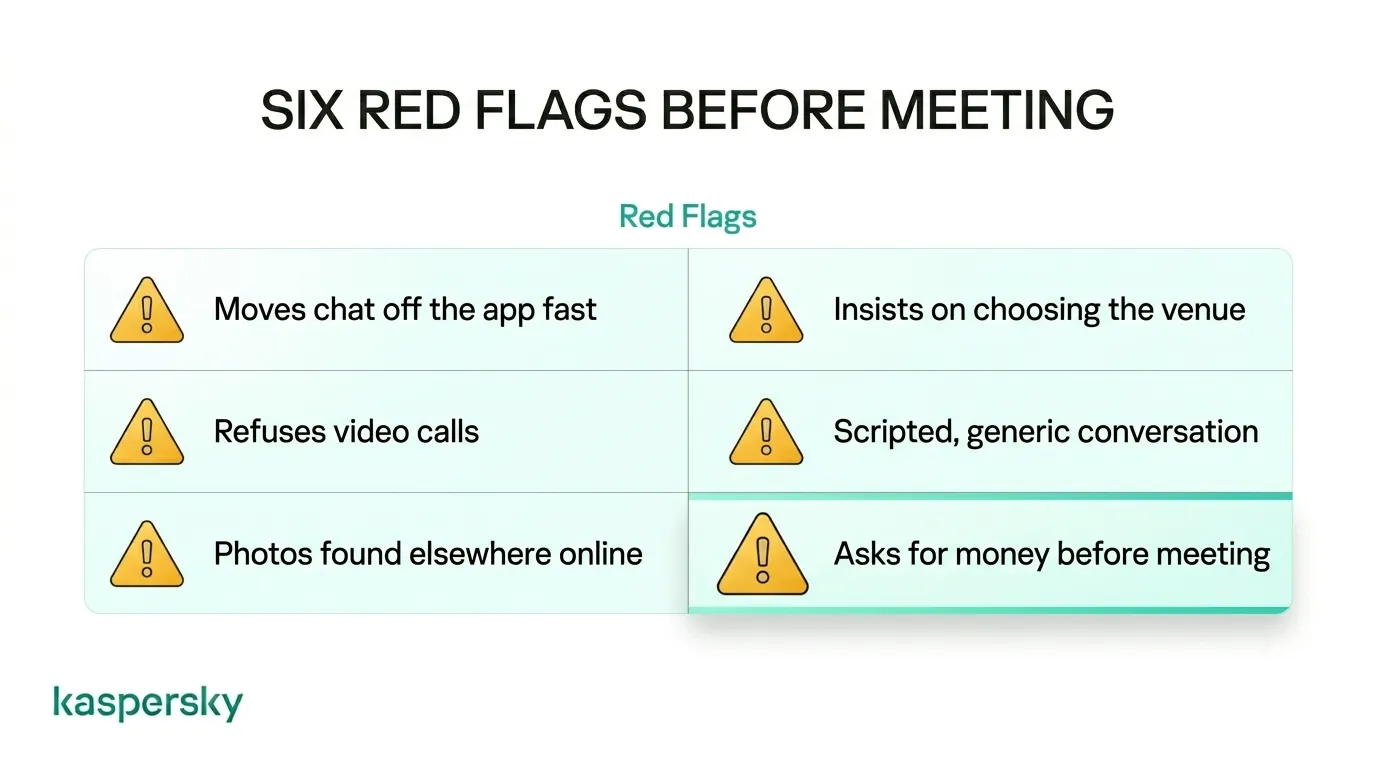 At a glance, the red flags worth pausing on are:
- A push to move off the dating app to WhatsApp, Telegram, or text within the first few messages.
- Repeated excuses to avoid a quick video call, even after you ask more than once.
- Photos that turn up under other names in a reverse image search.
- Flirting or compliments that feel generic, scripted, or oddly out of step with what you have said.
- Pressure to share personal details such as intimate photos, your full name, your workplace, or your address before you have met.
- Any request for money before a first meeting, however small or urgent the reason sounds.
Stop a hookup scam from reaching your bank or inbox
Hookup scams tend to chase the same prize: your email, your bank, and the photos on your phone. Kaspersky Premium combines phishing protection, a password manager, and identity monitoring across your devices, which can make it harder for a single bad link or shared detail to turn into a full account takeover.
Try Premium for FreeWhat should you do if you think you were scammed?
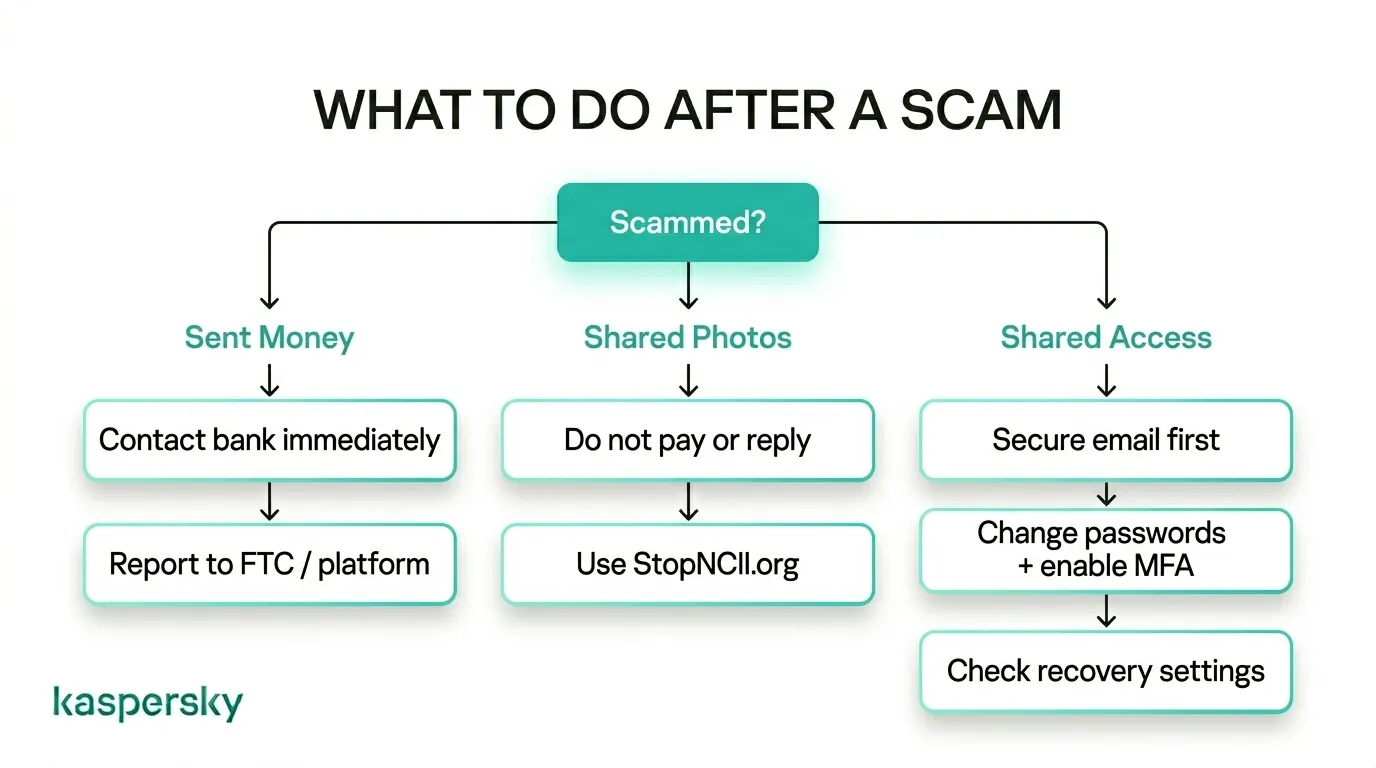
The right next step depends on what was shared, and in most cases, taking quick action helps.
If you sent money
The highest-impact first step is to contact your bank or payment provider immediately. Credit card payments are usually the easiest to reverse through a chargeback. Bank transfers can sometimes be recalled if you act before the funds are withdrawn. Wire transfers and crypto are rarely recoverable, but the provider may still flag the receiving account.
Keep screenshots of the conversation, the profile, and the payment details. Report the profile to the dating platform so they can spot the same scammer hitting other users with the same script and photos.
In the U.S., file a fraud report with the Federal Trade Commission at reportfraud.ftc.gov.
If you shared intimate photos
Do not reply, do not pay, and do not send more images. Take screenshots of the threats, the profile, and any payment demands before you block the account. If you negotiate or pay, you tell the scammer that pressure works, and the demands will usually escalate from there.
Adults can use StopNCII.org, a free global tool that helps block known intimate images from being shared on participating platforms including Meta, TikTok, Reddit, and Pornhub. The National Center for Missing & Exploited Children operates Take It Down for anyone who was under 18 when the content was created. In the U.S., the FBI's Internet Crime Complaint Center at ic3.gov accepts sextortion reports.
Tell a trusted person about the situation. The scammer is counting on your shame to keep you silent and paying. Once someone else knows, you take that leverage away.
If you shared a verification code or account details
Your email is almost always the priority, because whoever can get into your email can reset the password on your bank, your social media, and almost every other account you own. If the compromised account is your email, start there. If it's your dating app or social media, secure your email first, then come back to the compromised account.
For each account you're locking down, open it on a different device you trust and change the password. Log out every other active session if the platform offers that option. Turn on multi-factor authentication, and use an authenticator app rather than SMS, because scammers intercept SMS codes more easily than app-generated ones. A password manager like the one in Kaspersky Premium makes it easier to generate and store the new passwords without reusing the old ones across accounts.
Then open the recent login activity and the recovery settings on each account. Check for any backup emails or phone numbers you did not add yourself, and delete them. Attackers plant these to lock you back out after you change the password. If a dating-app or social account was taken over, report the compromise to the platform's support team so they can flag any messages the attacker sent from your account. If money moved or images were shared as part of the same incident, the steps in the sections above apply too.
You do not have to tell anyone in person what happened. File any reports privately, from your phone or laptop. Every report makes the next attempt a little harder to pull off.
Related Articles:
- What is a romance scam?
- What is sextortion? How to prevent and report it
- What is two-factor authentication?
- How to avoid social engineering attacks
Related Products:
FAQs
Why do hookup scammers try to move conversations to WhatsApp or Telegram?
Scammers push the chat to WhatsApp or Telegram to escape moderation and capture your real phone number. Dating apps hide your number and have reporting tools and scam detection. Moving off the platform drops those protections, and your number can be reused for further scams.
Are hookup websites with paid messaging always scams?
No. Paid messaging is common on legitimate sites. The quickest test is whether anyone will actually meet. Before spending much, check independent reviews for complaints about fake profiles or messages that lead nowhere while the site keeps prompting you to buy more credits.
Why do hookup scammers ask for gas money, Uber rides, or hotel costs?
Small requests work as a low-risk test of whether the target will pay. They also move easily through Cash App, Venmo, or gift cards. If $30 for gas goes through, a bigger ask usually follows. If the money doesn't come through, the scammer moves on to someone else.
Why do some hookup profiles seem too attractive or reply almost instantly?
Many of these profiles aren't real people. They use stolen photos, AI-generated images, or paid chat operators, and are often run at scale by organized groups. The aim is to keep targets engaged long enough to extract money, data, or paid-messaging credits.
Is it safe to send a selfie to verify I'm real?
Usually no, not before you've met. A request to "prove you're real" with a topless photo or a specific pose is often the setup for sextortion later. Real dating apps verify users inside the app, not by asking matches to swap photos with each other.
Can a one-night stand scam still happen if I meet the person in real life?
Yes. Bait-and-switch venues, inflated bar tabs, and after-meeting extortion all involve a real meeting. Meeting in person reduces the risk of catfishing and money-before-meeting scams, but it doesn't rule out scams that depend on you being there.